


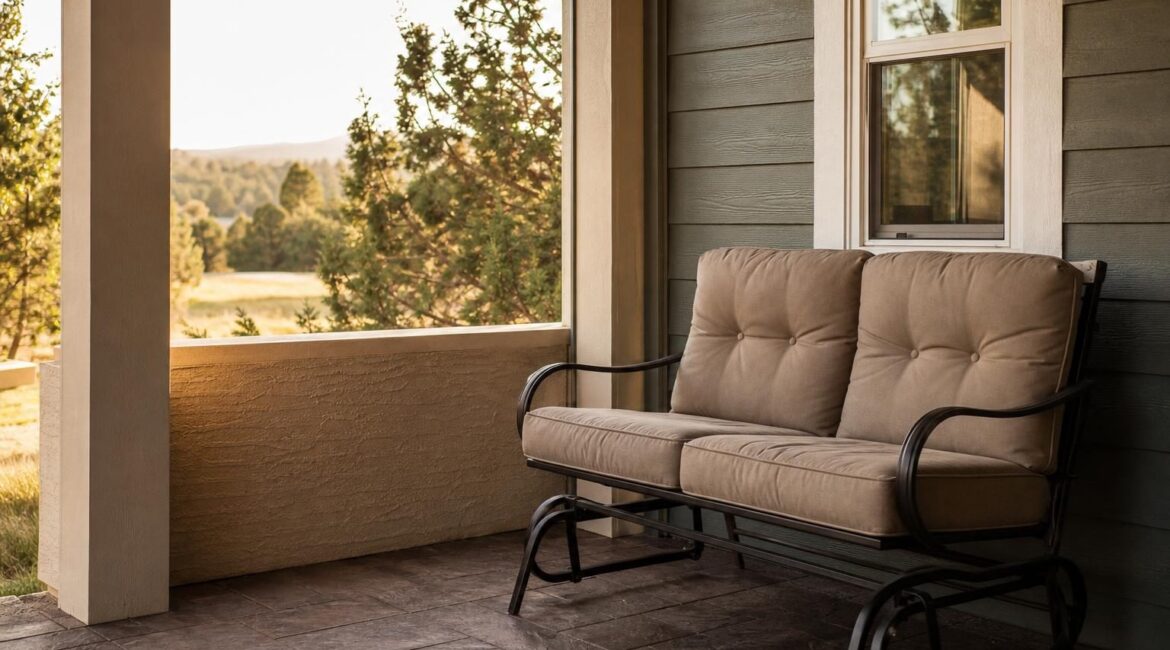
A cozy two-person spot is one of the most requested additions to a small porch, nook, or balcony, and patio loveseats and gliders are the two most common ways to create it. Both seat two people comfortably in a compact footprint, but they move differently, and that difference in motion is often the deciding factor once shoppers try both.
Beyond the motion question, frame material, cushion style, and placement all shape how a small two-person spot ends up feeling. A well-chosen loveseat or glider can become the most-used seat on the whole property, simply because it is scaled right for quiet, everyday moments rather than for entertaining a crowd. This guide walks through the practical differences and styling choices that make that kind of spot work.

Why Two-Seat Furniture Deserves Its Own Category
It is tempting to treat a loveseat or glider as simply a smaller version of a full sofa or sectional, but scaling down a large-seating design does not always produce the most comfortable two-person piece. Furniture built specifically as a loveseat or glider tends to have proportions tuned for two people rather than a scaled-down version of a group seating layout, which is part of why a dedicated two-seat piece often feels more comfortable in a small nook than a small sectional segment would.
Stationary Loveseats: Simple and Space-Efficient
A stationary patio loveseat sits still, much like an indoor sofa scaled down to a two-seat width. That stability makes it a straightforward fit for tighter nooks where a gliding or rocking motion would need extra clearance in front of and behind the piece to swing safely. Stationary loveseats also tend to have a slightly smaller overall footprint than gliders of a similar seat width, since there is no mechanism or extra frame depth needed for movement.
How Motion Type Affects Long-Term Comfort
Beyond initial impressions, motion type can affect how a piece feels over months of daily use. A well-built glider mechanism should move smoothly and quietly without excessive squeaking, and checking that motion in person is one of the best reasons to try a floor model before buying rather than ordering sight unseen. A stationary loveseat has no mechanism to maintain at all, which is part of its appeal for anyone who prefers the simplest possible long-term upkeep.
Gliders: Gentle Motion in a Compact Frame
A patio glider moves back and forth on a smooth, controlled track or swing-arm mechanism, offering a gentle rocking motion that many shoppers find relaxing for morning coffee or evening wind-down time. Because the motion is contained within the glider’s own frame rather than requiring a separate swing structure, gliders fit into porch and lanai spaces where a hanging porch swing would not have the ceiling support or clearance needed.

Gliders do need a bit of clearance in front of and behind the frame for the motion to work properly, so measuring your nook’s depth is worth doing before choosing a glider over a stationary loveseat in a tighter space.
Sizing a Loveseat or Glider to the Space
Most two-seat pieces range from about 45 to 60 inches wide, and measuring your nook’s actual width, not just its general size, will help narrow that range quickly. Leave a few extra inches on either side beyond the frame’s width for a side table or simply breathing room, since a loveseat or glider pushed flush against walls on both sides can feel more cramped than the seat width alone would suggest. For a glider specifically, remember to account for the arc of the motion when you measure, not just the frame’s resting footprint, since the seat travels forward and back as it swings and needs that clearance to move freely. Mapping the piece out with painter’s tape on the floor before buying is a quick way to confirm both the resting footprint and the swing path fit comfortably, and it makes it easy to picture where a side table or accent chair could sit without crowding the walkway.
Choosing Cushions for a Two-Person Nook
Because loveseats and gliders are viewed up close in a small, intimate space, cushion choice tends to matter more visually than it does on a larger sectional across the yard. A softer, more tailored cushion profile often suits a cozy nook better than an oversized deep-seat cushion designed for lounging, which can make a small loveseat feel bulkier than the frame actually is.

Coordinating the loveseat or glider cushion with a small side table or a single accent chair nearby helps a two-person nook feel like a finished space rather than an isolated bench tucked into a corner.
Frame Materials for a Two-Seat Piece
Aluminum-framed loveseats and gliders tend to be the lightest option, which matters more for a glider since a lighter frame combined with a smooth glide mechanism creates the most effortless motion. Wicker-wrapped frames add a furnished, textured look that suits a covered porch nicely, especially paired with a plush cushion. Poly lumber and marine-grade polymer gliders bring a more substantial, low-maintenance feel and are a popular choice for porches near the water, since there is no fabric cushion required for basic comfort, though most shoppers still add a cushion for softness.
Placement Tips for Porches, Nooks, and Balconies
Positioning a loveseat or glider to face a view — a garden, pool, or quiet street — makes the spot feel purposeful rather than incidental. On a covered porch, angling the piece slightly rather than placing it flat against a wall can make a small area feel more open. For balconies, measure railing height against the loveseat’s back height to make sure sight lines to the view are not blocked when seated.
Our showroom sets up both stationary loveseats and gliders so you can sit in each and feel the motion difference firsthand, which is honestly the easiest way to decide between the two for your specific nook. Take a few minutes in each, ideally with the same posture you would use during a typical morning or evening at home, before making the call.

Before settling on a loveseat or glider, review the maintenance requirements for its frame and upholstery. Tropitone’s product-care guidance is one manufacturer’s material-by-material reference.
Frequently Asked Questions
What is the difference between a patio loveseat and a glider?
A stationary loveseat does not move, similar to a small sofa, while a glider rocks gently back and forth on a built-in track or swing-arm mechanism. Gliders need a bit more front-to-back clearance for the motion to work.
How much space do I need for a patio glider?
You generally need clearance in front of and behind the glider frame for the gliding motion, in addition to the seat’s own footprint. Measuring your nook’s depth before choosing a glider helps avoid a cramped fit.
Are gliders comfortable for daily use?
Many people find the gentle back-and-forth motion of a glider relaxing for regular use, such as morning coffee or evening relaxation. Comfort also depends on cushion thickness and back support, which our showroom lets you test in person before making a final decision.
Can a loveseat or glider fit on a small balcony?
Yes, both come in compact sizes designed for smaller footprints. A stationary loveseat is usually the more space-efficient option for a very tight balcony, since it does not require extra clearance for movement. Measuring your balcony’s depth before shopping helps confirm which option fits comfortably.
Want to try a loveseat and a glider side by side? Visit our Tampa showroom or call (407) 299-9188 and we will help you find the right fit for your nook.
Explore Palm Casual
Factory-direct pricing with a risk-free 30-day trial. Visit a showroom or call (407) 299-9188.
Explore Our Buying Guides
Looking for expert advice? Read our Complete Guide to Patio Furniture in Florida or Ultimate Guide to Outdoor Furniture in Florida for tips on materials, maintenance, and choosing the right set for your space.
