


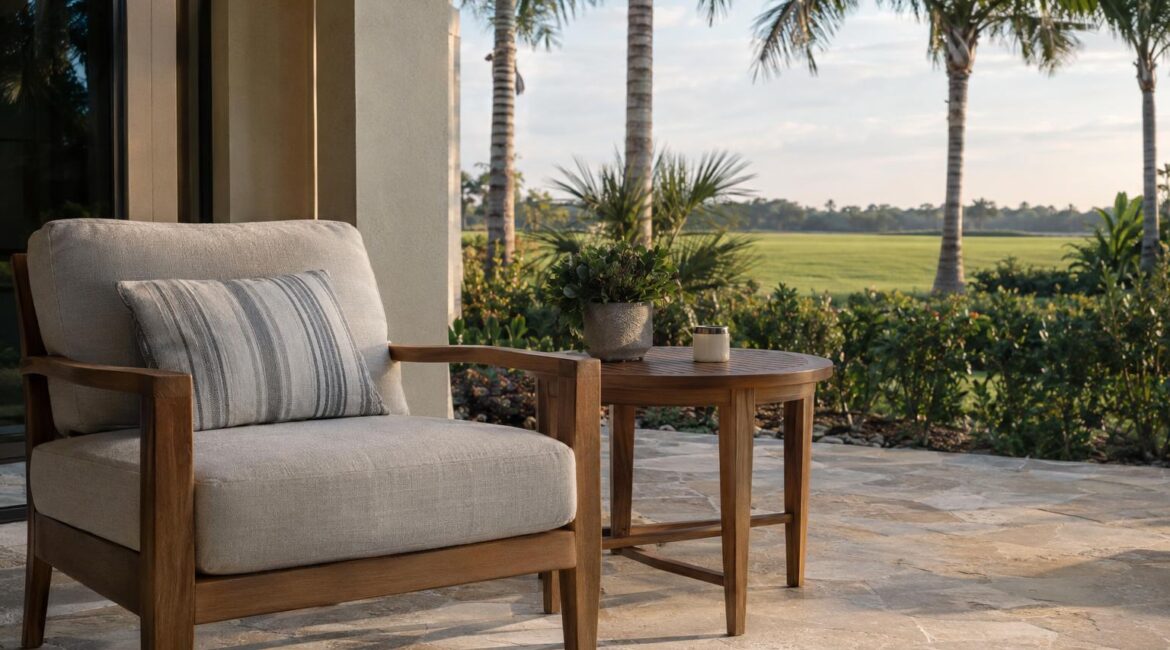
The table beside an armchair does a lot of small jobs. It holds a drink, catches a book or phone, and gives your elbow somewhere to land. When you are choosing a teak outdoor end table, the real question is shape: a round top or a square one. The two behave differently around chair arms, walkways, shins and corners, and the right pick usually comes down to how your seating is arranged. This page works through that choice using Palm Casual’s Teak Round End Table and Teak Square End Table.
Two Tables, One Decision: Footprint and Fit
Both tables belong to the same teak collection, so material is not what separates them. What separates them is how the top meets the space around it. You can look at each one on its own page: the Teak Round End Table and the Teak Square End Table. Ask the showroom to confirm the dimensions of each table before you plan around either one.
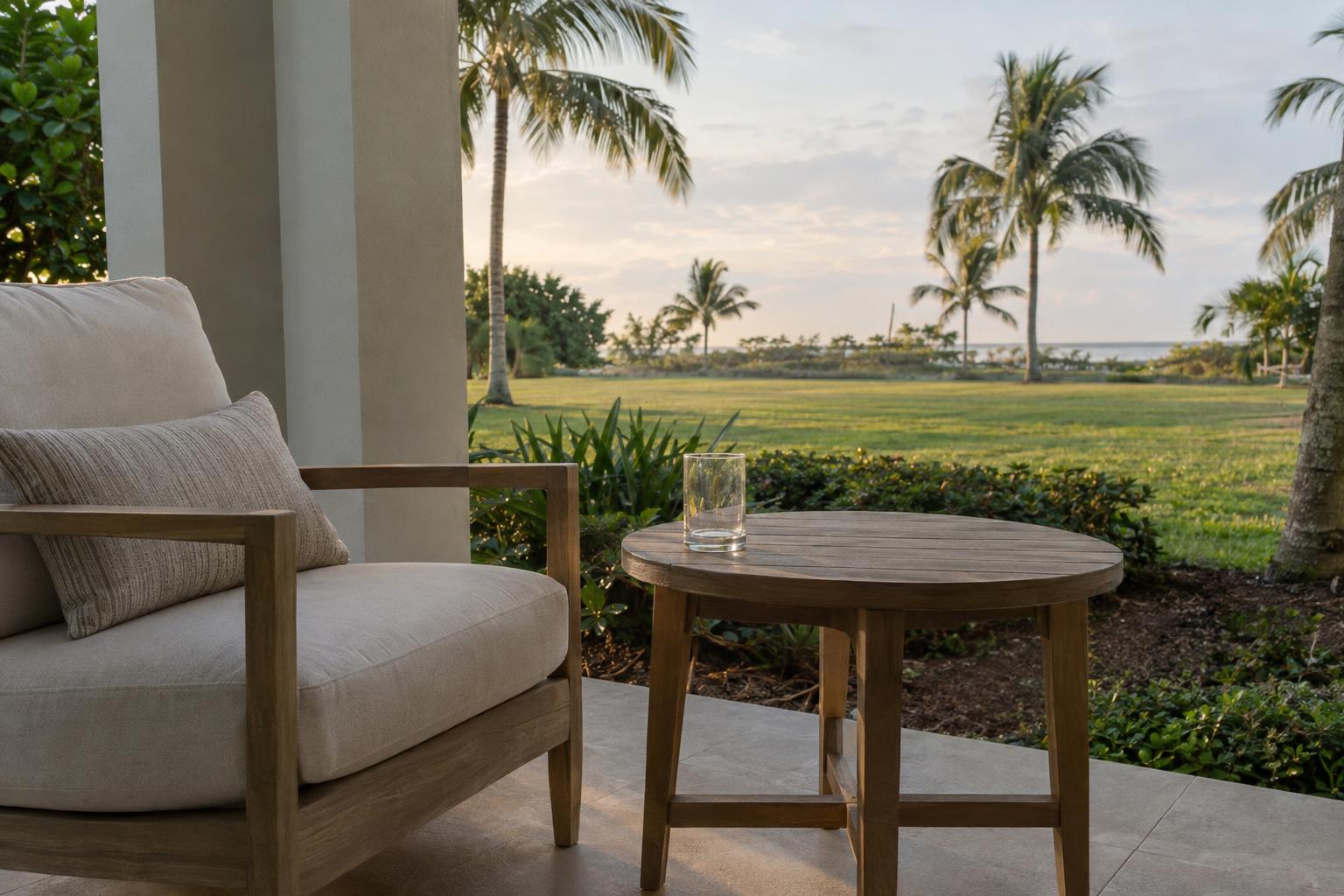
What a round top changes
A round top has no corners, so nothing sticks out at hip or shin height. That matters most where people walk past, because a corner is the thing people bump. A round top also tends to feel lighter in a small area, since the eye does not stop at a hard edge.
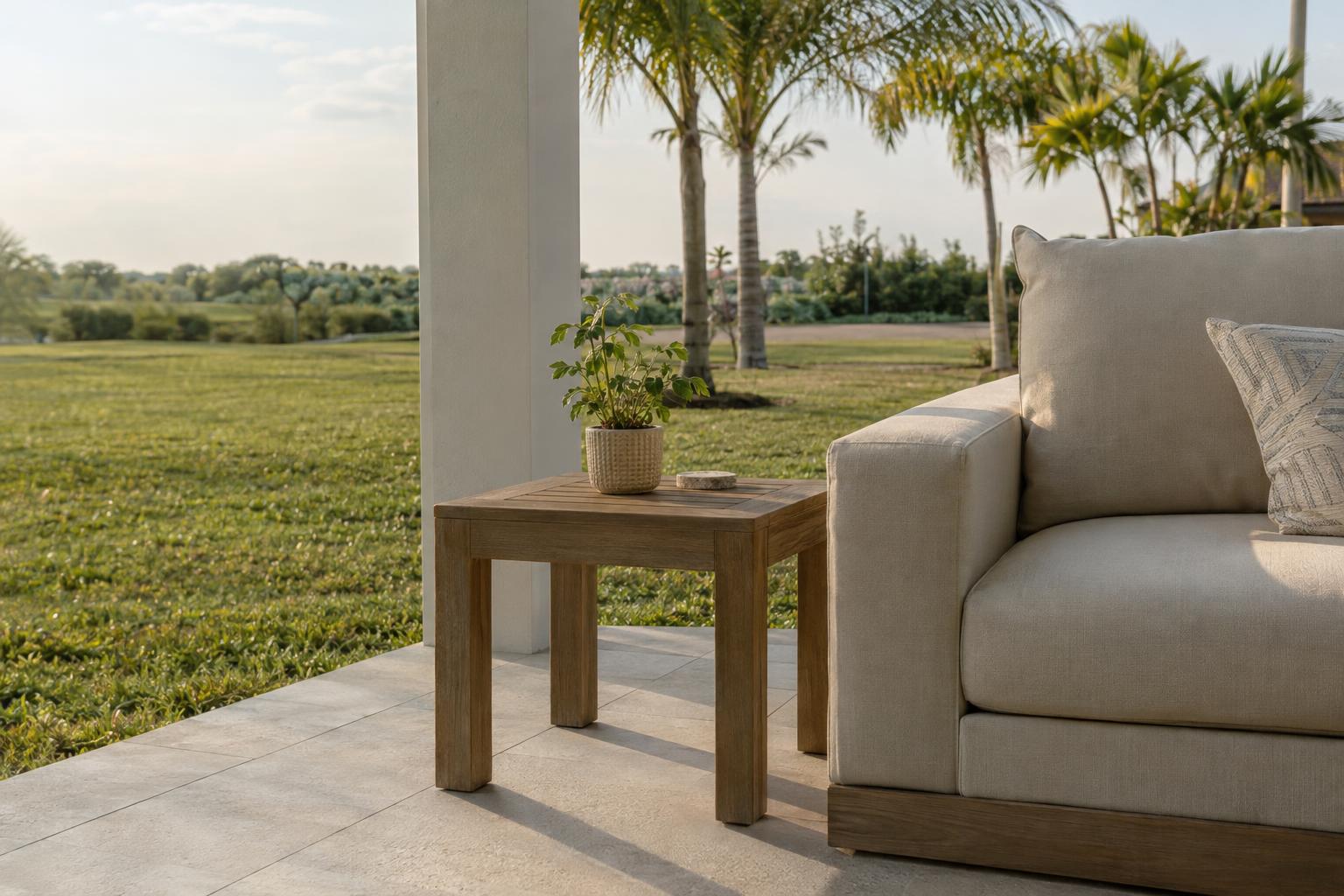
What a square top changes
A square top gives you flat edges to line up with other furniture. The surface in each corner is usable, so a lamp, a plate and a glass can sit without crowding the center. It reads as more structured, and that can suit a straight, tailored arrangement.
Beside an Armchair, Sofa End or Wall
An end table next to a chair needs to be close enough to reach without leaning and far enough away that you can still get in and out.
Why round helps with a chair that swivels or tilts
If you sit in a chair that angles, rocks or swivels, a round top lets the arm sweep past without catching. Because there is no corner, a chair can also tuck closer on a diagonal without the edge of the table meeting the arm.
Why square helps with a straight arm
A chair or sofa with a flat, squared arm lines up neatly with a square top, leaving an even gap along the whole side. That consistent gap looks tidy, and your drink stays in easy reach no matter where on the arm you rest.
Beside a sofa end, chaise or wall
The same logic applies at the end of a longer piece. Sit in the spot and imagine where the table will stand.
- At a sofa end: a square table lines up with the straight line of the arm, while a round table softens the end of a long run.
- Beside a chaise: a round table is easier to slide close to the cushion edge, because nothing sticks out where your legs swing around.
- Against a wall or railing: a square table sits flush, while a round one leaves small gaps behind it that collect leaves and dust.
- In a corner: a square table fits snugly, but you give up easy movement around it.
Drinks, books and the rest of the surface
Think about what actually lands on the table. A single glass and a phone rest happily on either shape. If you tend to set down a plate, a candle and a book together, the square top organizes those items in a line, while the round top asks you to arrange them around the center. Neither is a flaw, but it is worth picturing your own habits before you commit.
Tight Corners, Walkways and Shins
Walk the area as if you were carrying a tray. The place where people move through is the place where a corner hurts.
Narrow paths
If the table sits close to a path between the door and the yard, round is the more forgiving choice, because you can brush past without catching a hip. Use the placement checks in our article on end table placement tips for the patio to decide how much room to leave between table and path.
Table height and reach
Shape and height work together. A table that suits the chair arm in shape still has to match the seat height so you are not reaching up or down for a glass. The outdoor coffee table and side table height guide covers how to match them, and it applies to both of these tables.
Placing Two Tables and Pairing With Other Teak
If your seating has a chair on each side of a sofa, you may want a table at both ends. Matching shapes looks calm and intentional. Mixing a round and a square can also work if the rest of the arrangement has both soft and straight lines, but keep it to one of each so the grouping does not feel busy.
Think about the two-table case from the chair’s point of view as well. If one side of the seating faces a walkway and the other faces a wall, you might use a round table on the open side and a square one against the wall. That gives each side the shape that suits it, and it reads as a deliberate choice rather than a mismatch.
Pairing with other teak pieces
Teak pieces often look calmer together when they share a tone. Browse the full teak collection to see what else is in the collection. Because teak typically ages from a warm honey color toward gray, pieces bought at different times may look different for a while, so decide whether you want a matched or relaxed look.
How Teak Ages Outdoors and Where It Is Made
Teak is a dense hardwood known for natural oils, and The Wood Database notes that many consider it the gold standard for decay resistance. You can read that summary on the page about teak wood properties. Left alone outdoors, untreated teak typically weathers toward a silver-gray tone. Some owners prefer that look, and others re-oil the wood periodically to keep the honey color. Neither is wrong, and the choice is about appearance, so ask the showroom about any care routine you would like to follow.
Both tables are teak, so shape should not be a factor in that decision. If the table will sit in a sunny spot, its color may change along with the teak pieces nearby.
Made in Orlando and sold factory direct
Palm Casual’s teak collection is handcrafted at its Orlando facility and sold factory direct. Palm Casual has been in business since 1979. If a piece ever needs attention, in-house repair services and replacement-parts availability are part of what we offer. For more on how we work, read about our Orlando factory and history.
A Quick Way to Decide
- Choose round if people walk close to the table, your chair swivels, or the corner is tight.
- Choose square if the table sits against a wall, lines up with a straight arm, or needs a bigger usable corner.
- If you are undecided, picture the table in place and think about which edge you would rather touch with your shin.
Frequently Asked Questions
Is a round or square teak outdoor end table better for a small patio?
Round is usually easier in tight spaces because it has no corners to bump. A square table can still work against a wall or in a corner where nobody walks.
Can I mix a round and a square table in one seating area?
Yes, and it can look deliberate when the rest of the arrangement has both soft and straight lines. Keep it to one of each, and put the round table on the side where people walk past.
How big are these tables?
Ask your local showroom to confirm the dimensions of each table. Measure the space beside your chair before you decide.
Will teak turn gray outdoors?
Untreated teak typically weathers toward silver-gray over time outdoors. Some owners choose to re-oil it to keep the warmer tone.
To compare the two shapes in person, visit a Palm Casual showroom, or call (407) 299-9188 and our team will help you pick the table that fits your seating.
Explore Palm Casual
Factory-direct pricing with a risk-free 30-day trial. Visit a showroom or call (407) 299-9188.
Explore Our Buying Guides
Looking for expert advice? Read our Complete Guide to Patio Furniture in Florida or Ultimate Guide to Outdoor Furniture in Florida for tips on materials, maintenance, and choosing the right set for your space.
